Comfort is an understandable skin-care goal, but a scientific endpoint must be more specific. Does comfort mean less tightness after washing, fewer episodes of stinging, a smoother surface to touch, or a change visible to an examiner? Those possibilities need different measurements. Treating them as interchangeable can turn a narrow observation into a much broader promise about daily life.
This analysis uses the preliminary facial-estrogen conference report, related research and official regulatory material to examine how that translation should work. The explanations and hypothetical calculations below are methodological interpretation, not additional trial findings. The central question is whether a measurement captures the experience of interest, during the period that matters, with enough information about variation and missing observations to make the result useful.
Study figure and data
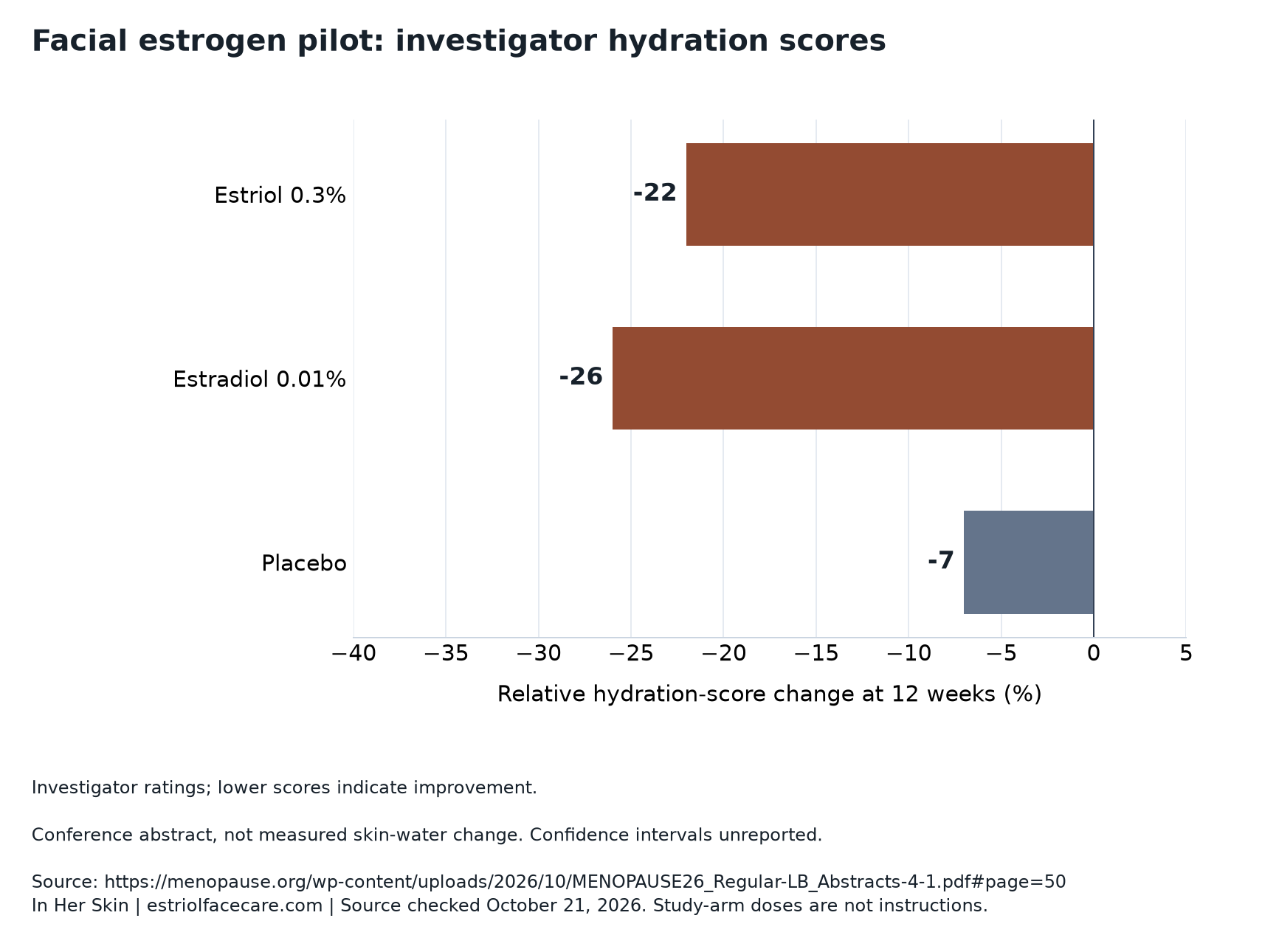
Facial estrogen pilot: investigator hydration scores
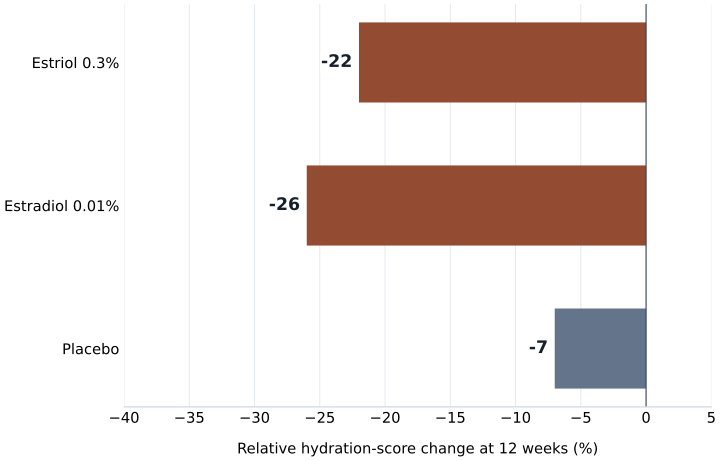
Investigator ratings; lower scores indicate improvement.
Conference abstract, not measured skin-water change. Confidence intervals unreported.
Download chart (PNG)Download data (CSV)Download vector chart (SVG)
| Historical study group | Reported value |
|---|---|
| Estriol 0.3% | -22 |
| Estradiol 0.01% | -26 |
| Placebo | -7 |
Start with the comparison the experiment created
Preliminary P-124 randomized 90 postmenopausal women aged 50–60 with photoaging, 30 per arm; 86 completed 12 weeks. It was double-blind, single-site and placebo-controlled. Investigator 0–4 ratings were primary.
Random allocation is a way to make treatment groups comparable before their outcomes are known. Blinding helps keep expectations from shaping assessments. Neither feature makes every recorded difference a treatment effect: chance imbalance, incomplete observations and the choice of analysis still matter. A placebo comparison asks what the tested ingredient adds within that experimental setting. It does not compare every possible everyday skin-care routine.
For interpretation, distinguish the question assigned at enrollment from the question answered among people with recorded follow-up. If people discontinue because their skin feels uncomfortable, an analysis limited to remaining participants may describe a selectively comfortable group. That is a hypothetical missing-data mechanism, not a claim about why anyone left this trial. A useful report would connect enrollment, completion and each endpoint denominator. Our guide to realistic estriol expectations offers a place to keep the intended care goal beside those evidence questions.
Give each measurement its own meaning
The indexed abstract of the older six-month study describes corneometry for hydration and profilometry for wrinkles. An instrument and an examiner can address related features without measuring the same thing. Their agreement is a question to investigate, not something established by calling both results skin improvement.
Consider an original measurement framework: first name what is being observed, then specify how it becomes a number. An ordered severity scale places categories in sequence; it does not automatically establish equal physical distances between them. An instrument produces a reading under particular measurement conditions. A person can describe discomfort across an evening that neither a photograph nor a brief appointment captures. This distinction matters when choosing a question about mature skin and basic care.
For a hypothetical example, an examiner could record the same surface score on two visits while a diary records three uncomfortable evenings before one visit and none before the other. Those observations are compatible because their time windows and targets differ. The framework below is an editorial proposal for organizing endpoints; it is not a reconstruction of any study questionnaire.
| Observation | Question it could address | Information needed for interpretation |
|---|---|---|
| Examiner severity rating | How does a defined feature appear at a visit? | Category definitions, assessor agreement and baseline distribution |
| Instrument reading | How did the measured property change under the test conditions? | Device method, units and repeatability |
| Comfort diary | How often did a defined sensation occur between visits? | Recall window, symptom definition and missing entries |
| Standardized photograph | Did the visible feature change under comparable viewing conditions? | Lighting, positioning and assessment procedure |
Distinguish statistical detection from a felt improvement
Fine-line, wrinkle, pore, tone and participant-efficacy comparisons were nonsignificant. Estriol firmness conflicts: positive narrative, table P=.077.
A result passing a statistical threshold and a result being large enough to matter are different propositions. Clinical importance needs an interpretable scale and a reason that a particular change matters to people. A statistical test instead evaluates how compatible observations are with a specified comparison model. Its result alone does not tell a reader how many people would notice improvement, how much relief they would feel, or whether a change would last.
Methodologically, disagreement between two ways of assessing an outcome invites examination of measurement sensitivity, timing and the feature each method targets. It does not authorize choosing whichever assessment creates the strongest headline. Nor does significance for one treatment and nonsignificance for another demonstrate that the treatments differ from each other; that needs their direct comparison. When narrative and numerical records disagree, the discrepancy should remain visible. The appropriate response is to identify the unresolved reporting problem and seek clarification, while keeping descriptive changes separate from claims that a comparison met its stated threshold.
Put the visit on a timeline
The older indexed treatment abstract followed 59 preclimacteric women receiving two active estrogen compounds for six months; a vehicle comparator, randomization and blinding are not established there. The abstract reports improved skin measurements, but its combined wrinkle-depth and pore-size percentage wording does not provide cleanly separated estimates. Prolactin increased significantly.
A longer observation period can ask a different question from an earlier visit, but duration alone does not repair a weak comparison. Likewise, an endpoint collected during treatment does not show persistence after treatment ends. For an illustrative timeline, imagine visits on days 1, 28 and 56. A comfortable day 56 could follow consistently comfortable weeks, fluctuating symptoms, or a difficult interval that recently resolved. The final visit cannot distinguish those histories without interval observations.
This is an interpretation about evidence and care planning: the interval being purchased should not be mistaken for the interval being scientifically evaluated. The annual-supply decision guide addresses the documentary side of that distinction. A research timeline needs its own questions about onset, persistence, interruptions and follow-up after exposure. Each requires an observation window rather than an assumption that one favorable visit represents every day around it.
| Time window | Question to specify | Evidence that would address it |
|---|---|---|
| Between scheduled visits | Was the experience steady or intermittent? | Repeated symptom observations with recorded missingness |
| At the planned endpoint | What changed relative to the comparison group? | Comparable baseline and endpoint assessments |
| After treatment ends | Does any change persist without continued exposure? | A defined period of post-treatment observation |
Describe tolerability as an observation process
Tolerability scales reported no issues.
The scientific meaning of tolerability depends on how experiences become data. A rating at an appointment, an unsolicited report and a daily question can capture different information. A useful protocol defines the sensations being sought, their intensity, their duration and whether they affect participation. It also records which people were asked and which observations are absent. None of these design choices should be replaced by the broad adjective gentle.
Here is a hypothetical completeness calculation. Twenty participants are asked to keep a diary for seven days: fourteen provide seven entries each and six provide three each. The record contains 116 of 140 planned daily entries, or about 82.9%. That fraction describes data completeness, not the percentage who tolerated a product. If missing entries cluster on difficult days, counting only completed entries could give a misleading impression. A tolerability analysis should therefore show symptom information and observation coverage together. It should also distinguish an experience reported after exposure from a conclusion that exposure caused it; timing is necessary to investigate causation, but timing alone does not settle that question.
Keep hormone exposure separate from skin comfort
Between-group serum-hormone comparisons were nonsignificant. Separately, the indexed three-month facial-ointment abstract included 17 women, nine receiving estradiol and eight estriol, and reported no significant hormone or vaginal-smear changes. Its abstract does not establish randomization or a vehicle comparison.
A blood measurement and a skin sensation address different biological questions. Even an excellent comfort record would not substitute for exposure measurements. Conversely, a hormone measurement cannot tell whether a surface feels tight. To interpret an assay, a reader needs the substance measured, the method’s detection capability, sampling times and variability. A value below a detection threshold is not a demonstrated value of zero.
An illustrative measurement example makes the distinction concrete: if an instrument cannot reliably distinguish readings below 0.2 arbitrary units, a reported below-threshold result leaves several smaller values compatible with the observation. Those units and that threshold are invented for explanation, not hormone data. Similarly, a nonsignificant group comparison does not establish that exposures are equivalent. An equivalence question requires a justified range of differences considered acceptably small and an analysis capable of excluding differences outside it. That is a separate evidentiary task from failing to detect a difference.
Read uncertainty before ranking outcomes
P-124 does not report confidence intervals, multiplicity handling or definitions of its ± terms.
A confidence interval expresses uncertainty around an estimate under a statistical model. A standard deviation describes dispersion among observations, while a standard error describes uncertainty in an estimated statistic. These are different quantities. An unexplained plus/minus term cannot be assigned whichever meaning helps a comparison. Nor can an interval be recovered responsibly without knowing the analysis, sample structure and what the reported quantity represents.
Multiplicity means testing several questions within one analysis program. As an explicitly hypothetical calculation, suppose ten independent tests each have a 5% false-positive probability when all their null hypotheses are true. The chance of at least one false positive is 1 minus 0.95 to the tenth power, approximately 40.1%. Actual skin endpoints may be correlated, so this is not a probability calculated for this trial. It explains why readers need to know which questions were prioritized and how multiple testing was handled. The solution is not to dismiss every positive result, but to separate planned confirmatory comparisons from findings that need further testing, and to inspect effect sizes alongside statistical thresholds.
Ask what a biological marker adds to the comfort question
The full 2008 skin-site article studied 70 volunteers across several experiments. Its separate facial experiment involved five women and five men over two weeks, without a randomized facial vehicle arm. No significant facial procollagen change was detected; serum estradiol increased with the historical 0.2% formulation. These observations cannot assign the same exposure to another cream. Pfizer partly supported Fisher; Voorhees disclosed Pfizer consulting.
A molecular marker is useful when it clarifies a biological response, but it sits at a different level from a person’s experience. A proposed chain might run from receptor activity to tissue remodeling to a visible or felt change. Each arrow needs evidence; detecting an early step does not establish the later ones. Our analysis of estradiol, collagen and skin site examines that research question in detail.
For interpretation, combining studies should begin with their differences in tissue, formulation, comparison and timing. It should not begin by pooling favorable numbers. A biochemical experiment can motivate a clinical hypothesis without estimating its practical benefit. Likewise, a clinical improvement would not prove a particular molecular mechanism unless that mechanism was tested. Keeping these levels distinct allows mechanistic research to inform the next experiment without turning it into a promise about comfort.
Make follow-up a care question rather than a purchase duration
FDA material checked October 21, 2026 states that no estriol-containing drug has FDA approval and that superior safety of estriol has not been established. Its compounding guidance explains that compounded drugs do not undergo FDA premarket approval for safety, effectiveness and quality; they are not approved generics.
The editorial implication is to define the care question before interpreting a purchase term. A follow-up discussion can specify the intended experience, how it would be assessed and which unresolved issues need professional evaluation. An annual quantity or renewal date is a transaction feature; it does not supply a clinical endpoint, demonstrate that an interval is appropriate, or establish continued benefit.
The options-and-records guide can help organize the documentation, while the CoreAge Rx review is a separate place to check recorded service terms. These links do not identify a studied retail formulation. A useful documentary comparison keeps formulation identity, dispensing information, follow-up arrangements and payment terms in separate fields. That structure makes it easier to see when a commercial document answers an administrative question while leaving the scientific or clinical question unanswered.
Design the next study around an interpretable experience
Alloy Health funded P-124; retail identity remains unestablished.
An editorial proposal for stronger evidence would start with a clearly defined patient-valued endpoint and an explicit threshold for meaningful change. Investigators could specify the recall period, record interval symptoms, standardize visit measurements and analyze participants according to a prespecified plan. Reporting would connect enrollment to every analysis denominator and explain how missing observations affect conclusions. Exposure sampling would address its own question with a defined assay and schedule.
The design should also separate an initial signal from durable benefit: repeated measurements during exposure and a planned period afterward would answer different parts of that problem. Disclosure of support helps readers assess research context, while independent replication tests whether findings persist in another setting. Neither a sponsor’s name nor a familiar ingredient establishes the identity of a retail medicine. The Alloy review offers a documentary reference for product and service records. Connecting a future study to routine care would still require a verifiable formulation match and evidence addressing the experience, population and duration actually under discussion.
Questions about the evidence
What would make a comfort endpoint useful?
It would name a specific experience, use a defined reporting period and show how change is interpreted. A hypothetical diary might distinguish frequency from intensity: two mild episodes and two severe episodes share a count but not a burden. An overall satisfaction question could be useful alongside that record, but would answer a broader question.
Can a percentage on a rating scale describe the percentage of people helped?
No. A relative change in a group’s score and a proportion of people meeting a response definition have different numerators and denominators. To estimate a responder proportion, researchers would need to define meaningful response, count qualifying individuals and specify who enters the denominator. A score change alone does not supply that information.
Why does a visit result leave everyday experience unresolved?
A visit samples a particular time. Experiences between visits require their own observations, and persistence after treatment requires follow-up after treatment. In a hypothetical diary, identical endpoint ratings could accompany quite different symptom histories. Reporting those histories would make the endpoint easier to interpret without assuming that one day represents the whole interval.
Does a nonsignificant hormone comparison establish equivalent safety?
No. Exposure, equivalence and safety are distinct questions. Safety also depends on which outcomes were sought, who was observed and for how long. A study designed around skin measurements cannot be assumed to resolve uncommon or delayed health outcomes merely because one laboratory comparison does not meet a statistical threshold.
What evidence would connect a study to a care decision?
The connection would need a clearly identified formulation, a relevant population, an interpretable benefit and follow-up that addresses the intended use. Documentary terms matter separately. Asking when a concern will be reassessed is different from asking when a subscription renews; neither answer should be inferred from the other.
Editorial assessment
For a skin-comfort question, the most useful evidence would connect a defined experience with repeated observations, a credible comparison and an interpretable amount of change. The reasoning here favors keeping those requirements visible instead of compressing several endpoints into an overall improvement claim. Follow-up becomes scientifically meaningful when it specifies what is being watched, for how long and what uncertainty remains. It becomes useful for a care discussion when that same question stays distinct from the terms of a purchase.
Research access and limitations
Evidence access comprises the conference abstract and complete table, the full 2008 skin-site article, indexed primary abstracts for the two older facial-treatment reports, and retained FDA material checked October 21, 2026. No fresh FDA check, review of all protocols or comprehensive long-term safety assessment is claimed. Hypothetical examples and proposed measurement frameworks are editorial reasoning, not observed participants or treatment instructions. Funding for the two older abstract-only reports remains unresolved.
Sources and access notes
Sources checked October 21, 2026. Access notes identify the material examined for this article.
- Menopause Society 2026 abstract P-124: pilot study of estriol or estradiol facial cream ↗Original 2026 conference abstract P-124 and its complete table, PDF page50; text and rendered page reviewed · Checked October 21, 2026Source-register context →
- Treatment of skin aging with topical estrogens. ↗Indexed primary study abstract · Checked October 21, 2026Source-register context →
- When applied to facial skin, does estrogen ointment have systemic effects? ↗Indexed primary study abstract · Checked October 21, 2026Source-register context →
- Induction of collagen by estradiol: difference between sun-protected and photodamaged human skin in vivo. ↗Primary full article: methods, main results, participant table, figure captions, discussion and funding reviewed on publisher site · Checked October 21, 2026Source-register context →
- FDA Office of Women’s Health: menopause and estriol approval questions ↗Official FDA consumer page read directly; brief regulatory summary retained · Checked October 21, 2026Source-register context →
- FDA: Compounding and the FDA—questions and answers ↗Official FDA questions-and-answers page read directly; concise editorial summary retained · Checked October 21, 2026Source-register context →