A person looking for more comfortable skin might mean less tightness after washing, fewer episodes of stinging, or a texture that feels easier to live with. A laboratory investigating collagen may be asking a different question. Both questions deserve careful measurement. The scientific challenge is to connect them without treating one answer as if it automatically supplies the other.
This analysis uses an endpoint-first reading framework: name what changed, identify the comparison, inspect the uncertainty, then ask whether the change would matter during ordinary life. The worked examples below are hypothetical teaching examples, not additional study results. They show why an impressive molecular number, a favorable visit rating and a durable improvement in comfort require different kinds of evidence.
Study figure and data
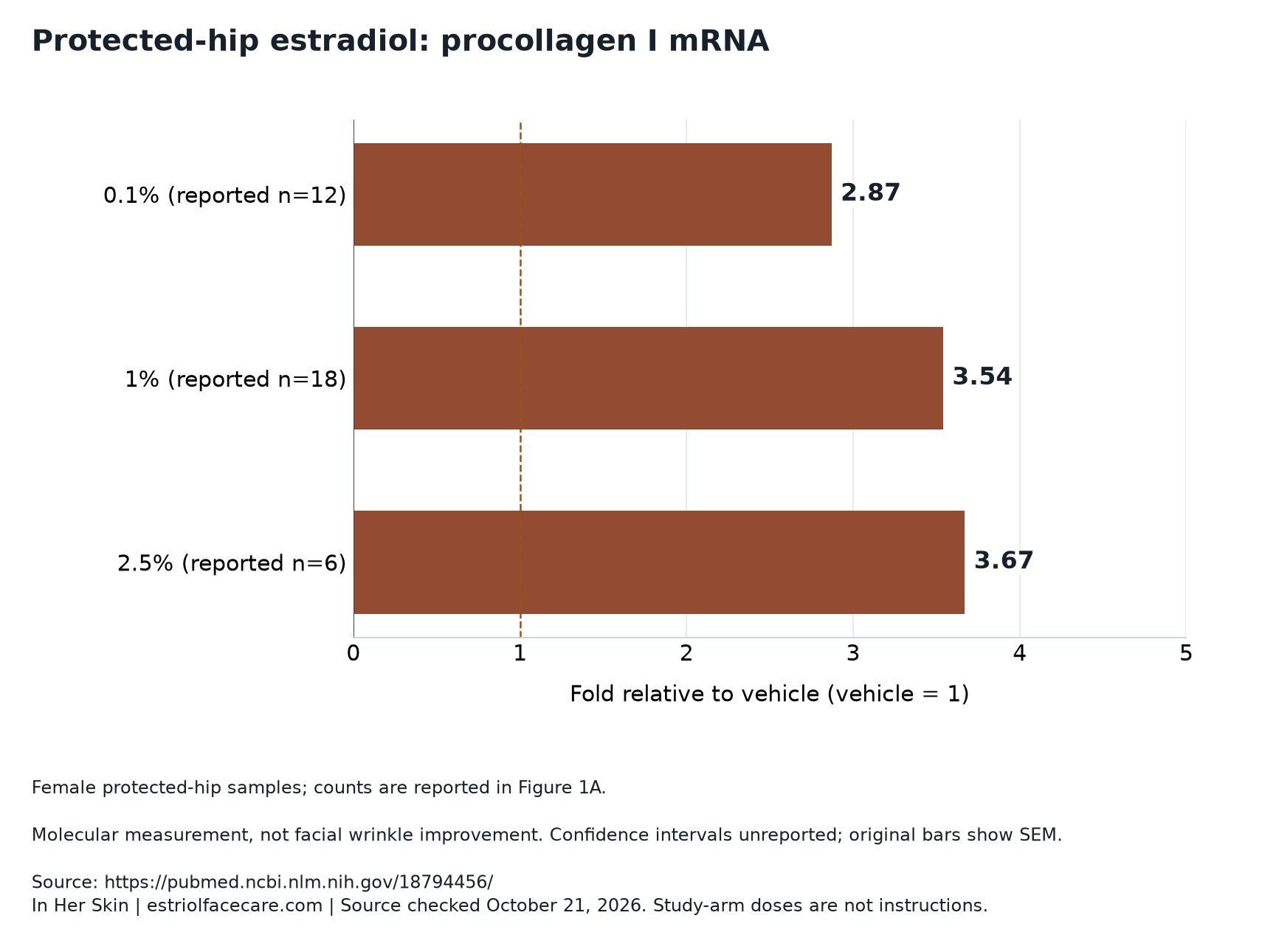
Protected-hip estradiol: procollagen I mRNA
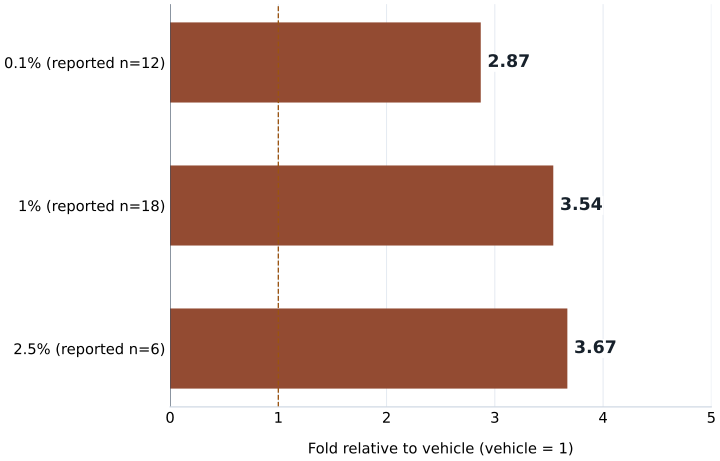
Female protected-hip samples; counts are reported in Figure 1A.
Molecular measurement, not facial wrinkle improvement. Confidence intervals unreported; original bars show SEM.
Download chart (PNG)Download data (CSV)Download vector chart (SVG)
| Historical estradiol study concentration | Reported value |
|---|---|
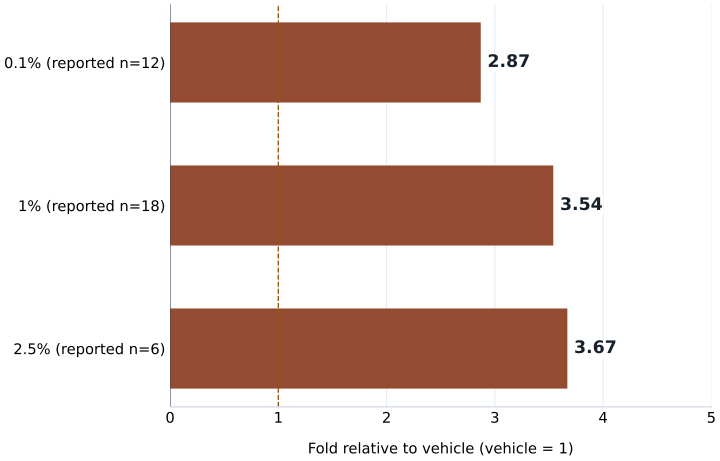
| 0.1% (reported n=12) | 2.87 |
| 1% (reported n=18) | 3.54 |
| 2.5% (reported n=6) | 3.67 |
Begin with the experience that needs an answer
As an editorial interpretation, the most useful starting point is a precise sentence: which aspect of skin should improve, for whom, and over what period? Consider two hypothetical goals: less evening tightness and a smaller wrinkle-depth measurement. They could both matter to someone, but an instrument designed for one question cannot be assumed to answer the other. Even the word better needs an object and a time frame.
A proposed comfort study could ask participants to record the frequency, intensity and duration of tightness separately. One severe episode and five brief mild episodes might receive the same overall weekly rating while representing different experiences. Asking whether a sensation interfered with washing, sleep or makeup would add a further dimension. These are suggestions for measurement, not claims that any estrogen study collected those observations.
The table separates possible questions without ranking them. A biological measurement may be valuable for explaining a pathway; a participant report may be valuable for describing an experience. Neither becomes more informative by being renamed. Our guide to mature skin and everyday care goals provides a place to frame the personal question before evaluating a study endpoint.
| Question being tested | Measurement to specify | Connection still needed |
|---|---|---|
| Does a biological signal change? | The named molecule and its assay | Whether that change predicts a valued outcome |
| Does skin feel more comfortable? | A defined sensation, scale and reporting period | Whether the difference persists in daily life |
| Does appearance change? | A specified feature and consistent assessment | Whether the measured difference is noticeable |
| Is the routine tolerable? | Symptoms, interruptions and reasons for withdrawal | Who remains represented in the final assessment |
Locate the comparison inside the experiment
In 2008, seventy volunteers (40 postmenopausal women, 30 men; averaging 75) contributed across experiments: one-week paired hip/forearm vehicle comparisons; separate two-week facial before/after testing, five per sex. Procollagen responses were detected in hip only. Facial 0.2% estradiol raised serum estradiol twelvefold in women, twofold in men. GREB1 indicated estrogen activity. Pfizer partly funded Fisher; Voorhees received Pfizer consulting payments.
For methodological interpretation, imagine measuring two matched skin areas in each volunteer. Comparing the areas within that person can account for characteristics shared by both areas. The unit of comparison is the person’s pair, so ten pairs do not become twenty independent volunteers. The vehicle, meaning the preparation without the active ingredient, also helps distinguish an ingredient-related difference from effects associated with the preparation itself.
A before-and-after comparison has another structure. A change between visits contains the treatment period alongside everything else that changed over time. Without a concurrent comparator, it is harder to separate those influences. Nor does comparing body sites by itself isolate the cause of a difference: a site is a bundle of characteristics, not a randomly assigned exposure history. These are design implications, not a demonstrated explanation of the observed pattern.
Translate a ratio without changing the outcome
The following arithmetic is illustrative. Suppose a molecular assay produces a value of 48 under one condition and 20 under its comparator. The ratio is 48 divided by 20, or 2.4-fold. The increase above the comparator is 28 units, or 140% of the comparator value. Calling that a 240% increase would confuse the final relative level with the increase. None of these calculations identifies a percentage of people who benefited.
Now suppose a second experiment produces 24 versus 10. It has the same ratio but half the absolute difference. Ratios alone cannot reveal the underlying scale, the precision of the assay or the practical importance of the difference. A small denominator can also make a ratio visually striking. Reporting the underlying measurements, when available, helps readers understand what produced the ratio.
As a measurement distinction, messenger RNA is a gene-expression readout; it is not itself a measure of skin softness or wrinkle depth. A proposed chain from molecular response to tissue change to visible or felt benefit needs evidence at its connecting steps. Our guide to realistic face-care expectations offers a complementary way to describe the desired endpoint without assigning it the size of an unrelated laboratory change.
Ask what the uncertainty interval would need to describe
In statistical interpretation, three quantities answer different questions. Standard deviation describes variation among observations. Standard error describes uncertainty in an estimated mean under the analysis assumptions. A confidence interval is an interval estimate constructed with a stated procedure and confidence level. A narrow standard-error bar should not be read as saying that nearly every participant had a similar response.
Consider a hypothetical estimate of a 0.4-point advantage on a symptom scale. An interval spanning a 0.2-point disadvantage through a 1.0-point advantage leaves materially different possibilities open. An interval from 0.35 to 0.45 points would be much more precise, but practical importance would still depend on the scale and what participants consider noticeable. Precision and importance are separate judgments, even when both matter.
Multiple measurements create another interpretation problem. If a study examines several outcomes, the reader needs to know which were planned as central tests and how the others were handled. A favorable result selected after inspecting everything has a different evidential role from a prespecified primary result. Missing statistical details cannot be supplied by a more confident adjective. Likewise, reported sample labels should not be added together without knowing whether they refer to overlapping people or independent groups.
Make tolerability observable between visits
The 2026 pilot reported no tolerability issues on investigator and participant scales; detailed adverse-event surveillance was not reported. That reporting boundary matters when deciding what the observation actually covers. As a proposed measurement framework, a tolerability record would distinguish a symptom, its timing, any interruption in use and its resolution. An uneventful assessment at one visit does not describe every intervening day.
Consider an explicitly hypothetical follow-up: 60 people start a routine, 50 return a questionnaire and 45 report acceptable comfort. The observed proportion among respondents is 45/50, or 90%. The proportion with documented acceptable comfort among all starters is 45/60, or 75%. Neither calculation supplies the missing ten people’s experiences. Treating everyone missing as satisfied or dissatisfied would introduce an assumption that should be visible.
The table shows information a future protocol could collect. Consistent questions make experiences comparable; recording free-text reasons can preserve information the scale missed. Product and service records require a separate reading task. The Alloy M4 documentary review is relevant for examining the offer’s public terms, without identifying a retail product as the research preparation or assigning it the study’s outcomes.
| Proposed record | What it would capture | What remains separate |
|---|---|---|
| Daily symptom diary | When a sensation occurred and how long it lasted | Whether the preparation caused it |
| Standardized severity question | Comparable intensity ratings | Whether the sensation disrupted daily activities |
| Interruption and withdrawal log | Who stopped, paused or missed assessments | An assumption that missing people were comfortable |
| Follow-up after an interruption | Whether the reported symptom persisted | A conclusion about uncommon systemic events |
Keep the scale beside the percentage
The randomized, blinded 2026 pilot compared facial estriol 0.3%, estradiol 0.01% and placebo over 12 weeks: 90 postmenopausal women aged 50–60, 30 per arm, 86 completers. Investigator ratings were primary; participant efficacy comparisons were nonsignificant. Alloy Health funded the abstract. The separate analysis of this facial pilot examines its findings in their own setting.
Here is an original numerical illustration, unrelated to those reported results. An aggregate score falling from 3.0 to 2.4 decreases by 0.6 points, or 20%. A score falling from 1.5 to 1.2 also decreases by 20%, but by only 0.3 points. A shared relative percentage therefore need not mean a shared absolute difference. Baseline values and the measurement scale belong beside a percentage.
If the categories are ordered descriptions, such as mild and moderate, equal numerical spacing does not automatically establish equal differences in experience. Aggregating ratings also hides how many people changed categories. One group could improve modestly across most participants; another could contain substantial improvement in a few alongside no change in the rest. Those patterns call for participant-level summaries. A percentage change in a rating is not a percentage change in water content or a responder proportion.
Distinguish time under observation from durability
The indexed abstract of an older study describes 59 preclimacteric women comparing topical estradiol and estriol compounds over six months, with a biopsy subset of ten. It reports increased prolactin; a vehicle comparison, randomization and blinding are not established by that abstract. Its combined wrinkle-depth/pore-size percentage does not provide separated estimates.
For interpreting follow-up, time has at least three meanings: duration of exposure, time when an outcome is measured, and duration for which a benefit persists. A measurement at the final treatment visit answers only part of that sequence. A proposed persistence study would define later assessments and record what happened between them. Continuing, changing or discontinuing other skin care would need documentation to interpret later differences.
A useful hypothetical contrast is a comfort score that improves early but returns to baseline before the next visit versus one that improves more slowly and remains lower. Their final photographs might look similar while their daily experiences differ. Repeated measurements could distinguish the trajectories; a single endpoint could not. As an editorial interpretation, the duration of a purchase is another clock entirely. The guide to annual estriol supply offers helps keep contract timing separate from evidence about sustained benefit.
Give systemic exposure its own question
Another indexed abstract followed 17 women using facial estrogen ointments for three months: nine estradiol, eight estriol. Hormone measurements and vaginal-smear findings showed no significant change. Funding and conflicts for both older studies remain unknown because their complete papers were not reviewed.
The methodological issue is what a measurement can exclude. A laboratory result below a detection threshold is an observation relative to the assay’s sensitivity, not a direct measurement of an exact zero. Sampling at one time can also answer a different question from sampling repeatedly across an exposure period. To interpret an exposure study, readers would want the assay, timing, variation and comparison specified before judging how much uncertainty remains.
Similarly, a nonsignificant test does not establish equivalence. Equivalence requires a justified boundary defining differences small enough for the particular question and an analysis designed to assess that boundary. Even strong evidence about a measured hormone difference would remain a different outcome from evidence about uncommon clinical events. Skin discomfort, circulating concentrations and later health outcomes require separate observation plans. This distinction does not determine an individual’s risk; it explains why one favorable measurement cannot complete every safety question.
Compare the question before comparing the headlines
As a cross-study interpretation, experiments can investigate related ingredients without estimating the same effect. Before treating two conclusions as contradictory, write each question in a common format: population, preparation, comparator, outcome and observation period. A mismatch in one element may explain why the studies cannot directly confirm or refute each other, even though both contribute useful information. It does not establish a biological explanation for different results.
Imagine two future studies of the same preparation. One measures a biopsy marker soon after exposure; another asks participants about discomfort during ordinary use. Agreement would be informative, but disagreement would also be possible without either measurement being wrong. To test whether the marker predicts comfort, researchers would need both measurements in a suitable design, with a prespecified relationship and enough information to assess it. Separate studies do not automatically supply that bridge.
This framework also applies when another ingredient appears in the discussion. The vitamin C evidence guide can be read by asking which endpoint and preparation support each claim. An ingredient name is a starting category, not a complete experimental description. Keeping separate questions separate allows a useful synthesis: identify what has been measured, then specify the study that would connect it to an unresolved care goal.
Describe the next evidence needed for a care decision
The retained October 21, 2026 FDA check states that no estriol-containing drug is FDA-approved. FDA’s compounding guidance distinguishes compounded medicines from products evaluated through premarket approval. Those statements concern regulatory status; they do not measure the size of a skin benefit.
An original research proposal centered on comfort would define the target sensation, comparator, assessment schedule and meaningful difference before enrollment. It would preserve outcomes for participants who interrupt treatment, explain missing data and report uncertainty alongside the effect estimate. Measuring both a biological marker and a participant-valued outcome could investigate whether they move together. Longer observation would need its own explicit question rather than merely adding another late visit.
For documentary review, the CoreAge Rx Time Out review and face-care options records guide offer places to examine public terms separately from research results. As editorial interpretation, a useful follow-up discussion starts with the intended outcome and how change would be assessed. A prescription or purchase record cannot fill a missing outcome measurement, while a laboratory finding cannot establish the terms of a service. Keeping those records distinct makes the remaining scientific question easier to state.
Questions about the evidence
What would connect a collagen result to better skin comfort?
As a study-design proposal, measure both in the same suitable population and specify the proposed relationship in advance. Researchers would need to examine whether changes in the marker reliably accompany a defined improvement in comfort. A biological rationale alone does not provide that predictive relationship.
Can a study miss a benefit people would notice?
Methodologically, that is possible if the chosen outcome does not capture the experience of interest, the assessment timing misses it, or the estimate is too imprecise. Those possibilities are questions for better measurement, not evidence that an unobserved benefit occurred. A future study should define the experience explicitly.
Why ask about people who stopped participating?
Their absence can change what the final group represents. The appropriate interpretation depends on why observations are missing and how the analysis handles them. A transparent report would describe missing assessments and explore reasonable assumptions, rather than quietly treating the remaining participants as everyone who began.
Would a statistically significant result settle practical importance?
No. Statistical significance addresses compatibility with a specified null model, given the analysis assumptions. Practical importance also requires the effect size, its uncertainty and a defensible interpretation of the measurement scale. A small precise difference and a large imprecise difference raise different questions for a reader.
Does a natural or bioidentical description resolve the product question?
FDA’s retained consumer guidance does not treat natural origin as a safety guarantee; bioidentical terminology does not distinguish an approved medicine from a compound. Editorially, the useful next step is identifying the exact preparation and the documentation attached to it, rather than assigning evidence on the basis of a category name.
Editorial assessment
The central editorial judgment is about fit: an outcome should fit the question a reader values, and the comparison should fit the claim being made. Molecular measurements can contribute to scientific understanding without supplying a comfort score. Follow-up can describe experience only within its observation window. A stronger evidence record would connect these measurements deliberately, retain missing participants in the accounting and make the remaining uncertainty visible beside the estimated benefit.
Research access and limitations
Unresolved: Table 1/Figure 1A women, 17/18; Figure 1B/text first protein dose, 0.01%/0.1%. The older studies are assessed from indexed primary abstracts, not complete papers. The facial pilot is a conference abstract; a separate author-conflict statement was not located. FDA context retains the October 21 check. The methodological examples and proposed measurement frameworks are editorial reasoning, not additional clinical findings.
Sources and access notes
Sources checked October 21, 2026. Access notes identify the material examined for this article.
- Induction of collagen by estradiol: difference between sun-protected and photodamaged human skin in vivo. ↗Primary full article: methods, main results, participant table, figure captions, discussion and funding reviewed on publisher site · Checked October 21, 2026Source-register context →
- Menopause Society 2026 abstract P-124: pilot study of estriol or estradiol facial cream ↗Original 2026 conference abstract P-124 and its complete table, PDF page50; text and rendered page reviewed · Checked October 21, 2026Source-register context →
- Treatment of skin aging with topical estrogens. ↗Indexed primary study abstract · Checked October 21, 2026Source-register context →
- When applied to facial skin, does estrogen ointment have systemic effects? ↗Indexed primary study abstract · Checked October 21, 2026Source-register context →
- FDA Office of Women’s Health: menopause and estriol approval questions ↗Official FDA consumer page read directly; brief regulatory summary retained · Checked October 21, 2026Source-register context →
- FDA: Compounding and the FDA—questions and answers ↗Official FDA questions-and-answers page read directly; concise editorial summary retained · Checked October 21, 2026Source-register context →